Internal Condom vs External Condom: What’s the Difference?
Internal vs External Condoms: The Main Difference
The main difference is simple:
- an external condom is worn on the penis
- an internal condom is worn inside the vagina or anus
Both are barrier methods. Both can help reduce the risk of pregnancy and STIs when used correctly. But they are not the same in how they are worn, who controls them, how they feel, or when they can be put in place.
The most important rule to remember is this:
Use one condom type at a time — never an internal and external condom together.
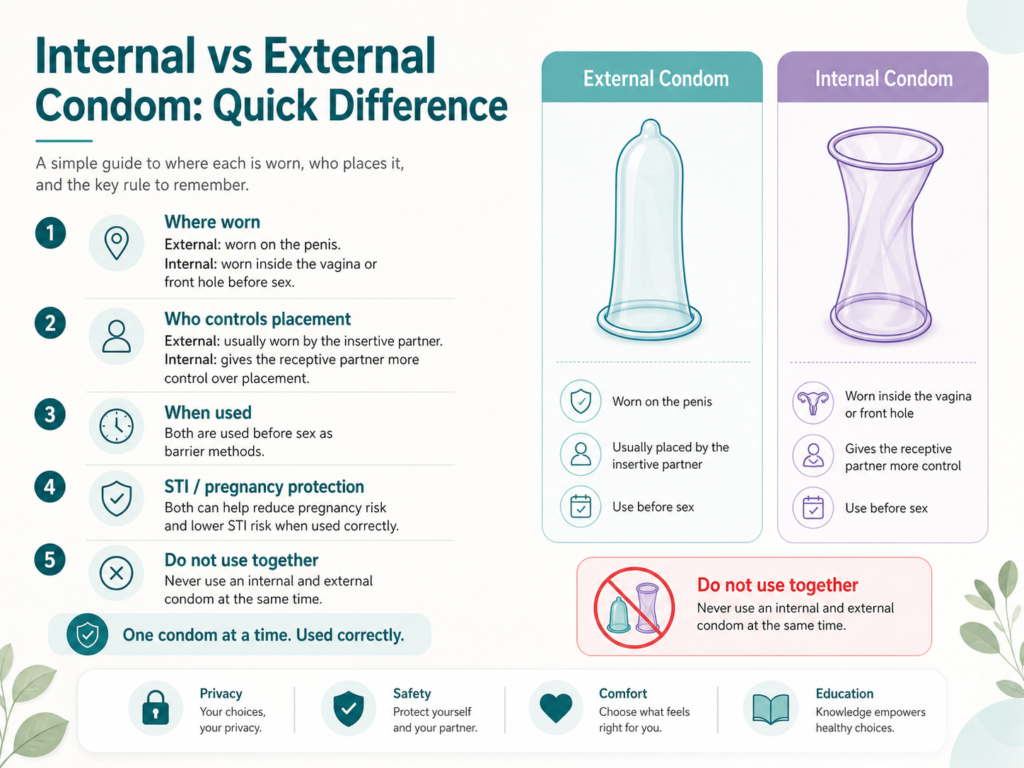
If you want the short version:
- External condoms go on the penis
- Internal condoms go inside the vagina or anus
- Both can help reduce pregnancy and STI risk
- Internal condoms may give the receptive partner more control
- External condoms are usually easier to find and more familiar
- Do not use them together, because friction can make one or both split
What Is an External Condom?
An external condom is the more familiar type for most people.
It is worn over the penis before sexual contact and acts as a barrier to help prevent semen and sexual fluids from passing between partners. External condoms are commonly used for:
- vaginal sex
- anal sex
- oral sex
They are usually the most widely available option and come in many variations, such as:
- different sizes
- different materials
- ribbed or dotted textures
- ultra-thin or thicker styles
- lubricated or non-lubricated versions
What Is an Internal Condom?
An internal condom is worn inside the body.
It lines the inside of the vagina or anus and acts as a barrier from the inside. It has rings that help keep it in place.
Some people prefer internal condoms because they can offer:
- a different feel
- more control for the receptive partner
- the option to insert protection before sex begins
That control point matters. Your source highlights that internal condoms can give the receptive partner more direct control over protection, which can be a major practical difference in real relationships.
Internal vs External Condoms: Quick Comparison
| Feature | External Condom | Internal Condom |
|---|---|---|
| Where it is worn | On the penis | Inside the vagina or anus |
| Who usually places it | Person wearing it on the penis | Receptive partner, or partner helping |
| Common names | Male condom, external condom | Female condom, internal condom |
| Used for | Vaginal, anal, oral sex | Vaginal sex; also used by some for anal sex |
| Availability | More widely available | Less widely available in many places |
| Control | More controlled by insertive partner | More controlled by receptive partner |
| Use together? | No | No |
| Main caution | Fit, lube, expiry, correct use | Placement, correct use, never with external condom |
The Key Differences That Matter in Real Life
1. Where they are worn
This is the most basic difference.
External condoms go over the penis.
Internal condoms go inside the vagina or anus.
That one difference changes:
- how they feel
- who puts them in place
- how early they can be used
- how much control each partner has
2. Who controls placement
External condoms are usually controlled by the person wearing them on the penis.
Internal condoms can be inserted by the receptive partner, which may give that person more direct control over safer sex.
This can matter a lot in situations where:
- one partner wants more say in protection
- people want to prepare before sex
- external condoms feel less practical or less preferred
That makes internal condoms not just a different product, but a different kind of control option.
3. When they can be put in place
External condoms are put on before sexual contact begins.
Internal condoms may be inserted before sex starts, which some people prefer because it allows more preparation and less interruption in the moment.
That can be a real advantage for people who want:
- less pause during sex
- more preparation beforehand
- more control over timing
4. Comfort and sensation
Comfort is personal.
Some people prefer external condoms because:
- they are familiar
- they come in many fit options
- they feel simpler to use
Others may prefer internal condoms because:
- they may feel less tight on the penis
- the receptive partner has more control
- the rings may feel different during use
The best choice is not always the most common one. It is the one that feels acceptable, practical, and comfortable enough to use correctly every time.
5. Cost and availability
External condoms are usually:
- easier to find
- more widely sold
- less expensive
Internal condoms are often:
- more costly
- less commonly stocked
- harder to find in some markets
This matters in real life because availability often affects what people actually use, not just what they might theoretically prefer.
Do Both Protect Against Pregnancy and STIs?
Yes.
Both internal and external condoms can help reduce the risk of:
- unintended pregnancy
- many STIs
when used correctly and consistently.
That said, the same general rule still applies:
Condoms reduce risk — they do not eliminate risk completely.
So whichever type someone chooses, correct use still matters:
- the right fit
- proper placement
- intact packaging
- correct timing
- good technique
Can You Use an Internal and External Condom Together?
No.
Do not use an internal condom and an external condom together.
It may sound like extra protection, but it actually creates extra friction. That friction can make:
- one condom split
- both condoms split
- the condoms move incorrectly during use
This is the same logic behind why “double bagging” is not recommended. One condom used correctly is safer than two barriers rubbing against each other.
Which One Should You Choose?
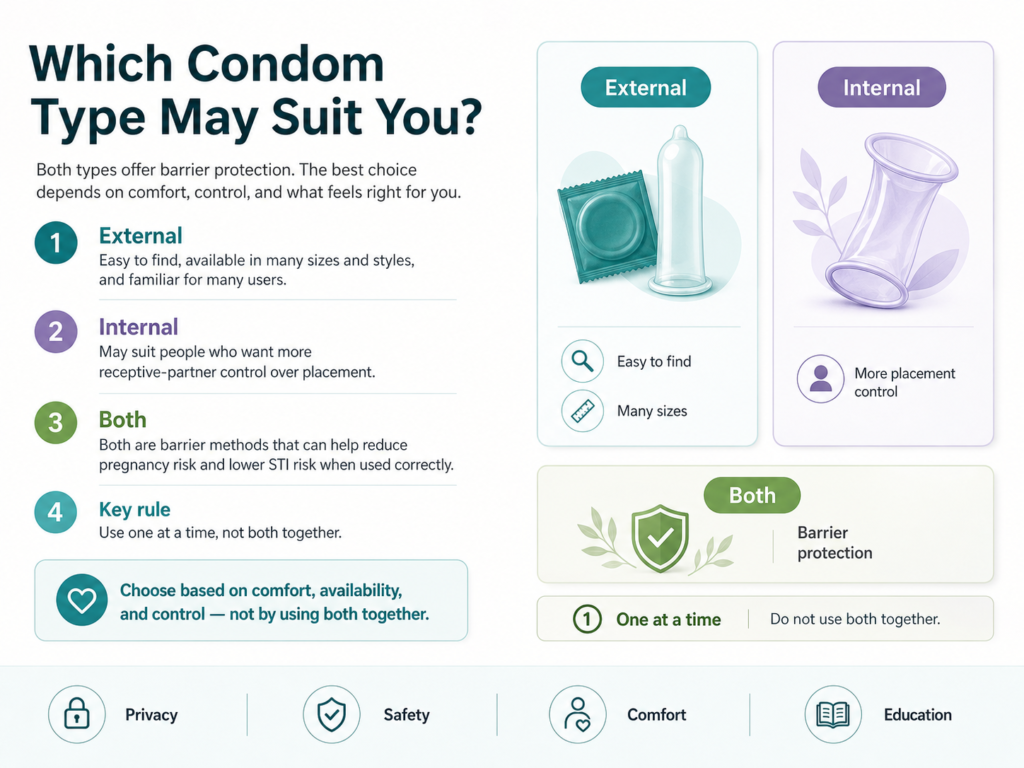
Choose an external condom if:
- you want the most widely available option
- you want different sizes, textures, and material choices
- the person wearing it is comfortable putting it on correctly
- you want a familiar barrier method for vaginal, anal, or oral sex
Choose an internal condom if:
- the receptive partner wants more control over protection
- external condoms feel too tight or uncomfortable
- you want a barrier that can be placed before sex
- you want to try a different option and are able to use it correctly
This is not about one being universally better than the other.
It is about:
- what fits the situation
- what feels more acceptable
- what can be used correctly and consistently
Common Mistakes to Avoid
1. Using internal and external condoms together
This is not recommended because friction can make one or both split.
2. Reusing either type of condom
Both are single-use only. Reuse is not safe.
3. Using oil-based products with latex condoms
Oil-based products can damage latex and increase breakage risk.
4. Waiting too long to put on an external condom
An external condom should be put on before sexual contact begins, not just before ejaculation.
5. Letting the penis go beside the internal condom instead of inside it
With internal condoms, placement matters. If the penis goes outside the condom but inside the vagina or anus, the barrier is not working as intended.
Myth vs Fact
Myth: Internal and external condoms are basically the same
Fact: They are both barrier methods, but external condoms are worn on the penis while internal condoms are worn inside the vagina or anus.
Myth: Internal condoms are only for women
Fact: Internal condoms can be used by people who want an internal barrier method for pregnancy and STI protection.
Myth: Using both together gives double protection
Fact: No. Using them together can make one or both split because of friction.
Myth: External condoms are the only condoms that reduce STI risk
Fact: Both internal and external condoms can reduce STI risk when used correctly.
Myth: Internal condoms are always easier
Fact: Not always. Some people like the control and timing, but correct placement can take practice.
FAQ
1. What is the main difference between internal and external condoms?
External condoms are worn on the penis. Internal condoms are worn inside the vagina or anus.
2. Are internal condoms as effective as external condoms?
Both can reduce pregnancy and STI risk when used correctly.
3. Can you use an internal condom and external condom together?
No. They should not be used together because this can make one or both split.
4. Who may prefer an internal condom?
Someone who wants receptive-partner control, wants to place protection before sex, or finds external condoms uncomfortable may prefer an internal condom.
5. Are internal condoms only for vaginal sex?
They are commonly discussed for vaginal sex, though some people also use them for anal sex. Correct use and placement still matter.
6. Are external condoms easier to find?
Usually, yes. External condoms are more widely available and generally less expensive.
7. Do both protect against STIs?
Yes, both can reduce STI risk when used correctly, though no condom eliminates risk completely.
Final Takeaway
The difference is simple:
- external condoms are worn on the penis
- internal condoms are worn inside the vagina or anus
Both are barrier methods, and both can reduce pregnancy and STI risk when used correctly and consistently.
The most important rule is this:
Choose one condom type at a time, use it correctly, and never use an internal and external condom together.
If you want more control, an internal condom may be worth exploring. If you want the most common and widely available option, an external condom is usually easier to start with.
Medical Disclaimer
This article is for general educational purposes only and does not replace medical advice. If you have concerns about contraception choices, STI risk, condom fit, or irritation, speak with a qualified healthcare professional or sexual health clinic.