Does Lube Expire? How to Tell if Personal Lubricant Has Gone Bad
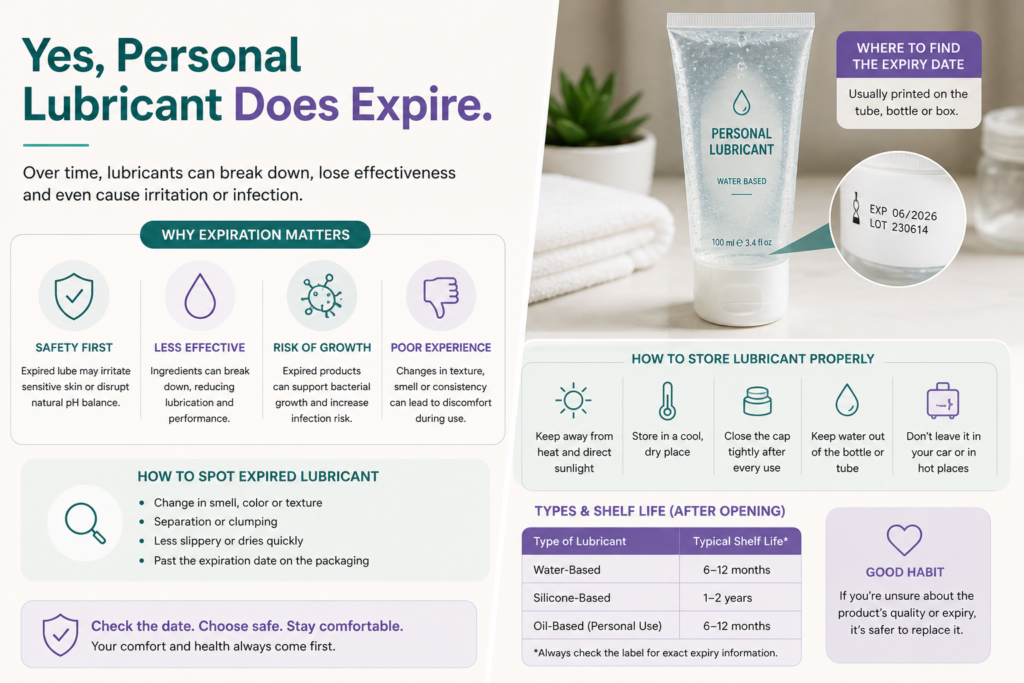
Yes, personal lubricant does expire.
It is not a product that should be treated as permanent just because the bottle still has some left in it. Like other body-contact products, lubricant is made with ingredients chosen for texture, stability, preservation, and comfort — and those qualities do not stay unchanged forever.
That is why the safest rule is simple:
Check the expiration date first, then pay attention to any changes in smell, texture, colour, packaging, or how your skin reacts.
If the lube is expired, smells off, feels different, or causes irritation, it is better not to use it.
Quick Answer
If you want the short version:
- Yes, lube expires
- Check the printed expiration date
- Do not use it if it smells strange, feels different, looks unusual, or causes irritation
- If you are unsure about how long it has been open or how it was stored, replacing it is usually the safer choice
Why Lube Expires
Lube is a formulated product, not a forever product.
It contains ingredients designed to:
- reduce friction
- improve comfort
- stay stable over time
- remain body-compatible
But those qualities can change as the product ages.
That is why manufacturers give lubricants a shelf life or expiration date instead of treating them as products for indefinite use. Once a lubricant passes that point, there is less reason to trust its texture, preservation, and intended performance.
This does not mean every bottle becomes instantly dangerous the day after expiry. It means the product is no longer something you should trust casually.
How Long Does Lube Usually Last?
There is no one rule that fits every brand and every formula. The label on the product is always the most reliable guide.
That said, your source content highlights a useful general pattern:
- Most personal lubricants last around 1 to 3 years with proper storage
- Water-based lubricants may have a shorter lifespan
- The printed date on the product matters more than broad internet guesses
So the best rule is:
Trust the bottle in your hand more than generic advice.
Does Water-Based Lube Expire Faster?
Often, yes.
Water-based lubricants may have a shorter lifespan than some other types. That does not mean every water-based lube expires quickly, but it does mean they often deserve extra attention when checking dates and condition.
This matters because many people assume:
- if the bottle is not empty, it should still be fine
- if it looks mostly normal, it should still work
But shelf life depends on the formula, storage, and condition — not just how much is left.
How to Tell If Lube Has Gone Bad
There are a few warning signs that matter most.
1. The expiration date has passed
This is the first and easiest thing to check.
If the product is past its printed expiration date, it is smarter to replace it than to gamble on a body-contact product.
2. The texture has changed
Do not use it if the lube has become:
- unusually watery
- overly sticky
- clumpy
- grainy
- separated
- noticeably different from how it normally feels
Lubricant is supposed to perform predictably. If the formula now behaves differently, that is already a reason to stop trusting it.
3. It smells off
A strong, sour, chemical, or clearly unusual smell is another warning sign.
Some lubricants naturally have very little scent. Others may have a mild scent by design. But if the smell is noticeably different from what the product normally smells like, it is safer not to use it.
4. The colour looks unusual
Colour changes deserve attention, but colour alone is not always enough to judge a product.
A better approach is to look at colour changes alongside:
- expiry date
- smell
- texture
- bottle condition
- skin reaction
So colour can be a warning sign — but it should be judged together with the rest.
5. The bottle or seal is damaged
Do not trust the product if:
- the cap does not close properly
- the bottle has leaked
- the packaging seems compromised
- the seal was broken long ago
- residue has built up around the opening
Packaging matters because the product is used on sensitive tissue.
6. It causes irritation
If the lube suddenly causes:
- burning
- itching
- redness
- discomfort
- unusual sensitivity
stop using it.
Irritation does not always mean the lube is expired, but it does mean the product is not a good choice for your body at that point.
Can Expired Lube Cause Problems?
Potentially, yes.
The most likely problems are not dramatic. They are usually things like:
- reduced performance
- more friction than expected
- unpleasant texture
- irritation
- lower comfort during use
That still matters a lot.
Lubricant is meant to reduce friction and improve comfort. Your source also notes that good lubrication can support condom performance by lowering friction-related risk.
So expired lube is not just a cosmetic issue — it can affect both comfort and overall reliability.
Does Opened Lube Expire Faster?
Often, it deserves more caution once opened.
Opening the bottle introduces:
- air exposure
- repeated hand contact
- more chances for contamination
- more storage stress
There is no single universal “opened bottle” timeline that fits every brand. But the safest real-world rule is:
- monitor opened products more closely
- do not stretch their life unnecessarily
- replace them sooner if anything seems off
If you already feel unsure about an opened bottle, that uncertainty itself is often a good enough reason to replace it.
How to Store Lube Properly
The best storage advice is simple:
- keep it closed
- keep it clean
- keep it dry
- keep it away from avoidable heat
Good storage habits:
- keep the cap tightly closed
- store it in a cool, dry place
- avoid direct sunlight
- avoid long-term storage in a hot car
- do not leave it open in a humid bathroom unnecessarily
- keep the bottle clean around the opening
Proper storage helps the product last the way it is supposed to.
When to Throw Lube Away
Throw it away if:
- the expiration date has passed
- the formula looks separated, clumpy, unusually runny, or otherwise different
- the smell has clearly changed
- the bottle or seal is damaged
- it causes burning, itching, redness, or discomfort
- you are not confident about how long it has been open or how it was stored
This is the simplest real-world rule:
If trust in the product is low, replacement is the smarter option.
Common Myths About Expired Lube
Myth: Lube does not really expire
Fact: It does. Personal lubricants come with expiration guidance and should not be treated as indefinite-use products.
Myth: If the bottle is half full, it should still be fine
Fact: Remaining quantity does not tell you anything useful about stability or expiry. The date and condition matter more.
Myth: Any colour change means the lube is bad
Fact: Not always. Colour should be judged alongside smell, texture, expiry, and bottle condition.
Myth: Expired lube is only a comfort issue
Fact: Comfort is a major part of it, but lubrication also helps reduce friction, which can matter for condom reliability too.
FAQ
1. Does personal lubricant really expire?
Yes. Personal lubricants have expiration guidance and should not be treated as products that last forever.
2. How can I tell if lube has gone bad?
Start with the printed expiration date. Then check for changes in texture, smell, colour, packaging, or irritation during use.
3. Can expired lube cause irritation?
It can. If a lubricant causes burning, itching, redness, or discomfort, stop using it.
4. How long does opened lube last?
There is no single universal timeline for every brand once opened. Follow the label date and replace it sooner if smell, texture, or packaging changes.
5. Does water-based lube expire faster than silicone lube?
Often, yes. Water-based lubes may have a shorter lifespan depending on the formula.
6. Can I still use lube if it is not expired but seems different?
It is better not to. If it seems separated, sticky, watery, clumpy, or smells wrong, replacing it is the safer choice.
7. Does lube affect condoms?
Yes. The right lubrication can help reduce friction, which can matter for condom comfort and performance.
Final Takeaway
Yes, personal lubricant expires.
The safest way to judge it is simple:
- check the expiration date
- look at the texture
- notice any smell changes
- pay attention to colour and bottle condition
- stop using it if it causes irritation
For most readers, the best rule is:
Fresh, properly stored lube is inexpensive peace of mind. Questionable lube is not worth the risk.
Medical Disclaimer
This article is for general educational purposes only and does not replace medical advice. If you experience persistent irritation, burning, redness, or discomfort after using lubricant, consult a qualified healthcare professional.