Are Condoms 100% Safe? Effectiveness, Failure Rates, and Common Myths
No — condoms are not 100% safe, but they are still one of the most effective ways to reduce the risk of unintended pregnancy, HIV, and many sexually transmitted infections (STIs) when used correctly and consistently.
A lot of people assume “safe” means zero risk. In reality, no barrier or contraceptive method offers absolute protection. What condoms do offer is strong risk reduction — and in many cases, that makes them one of the smartest and most practical sexual wellness tools available.
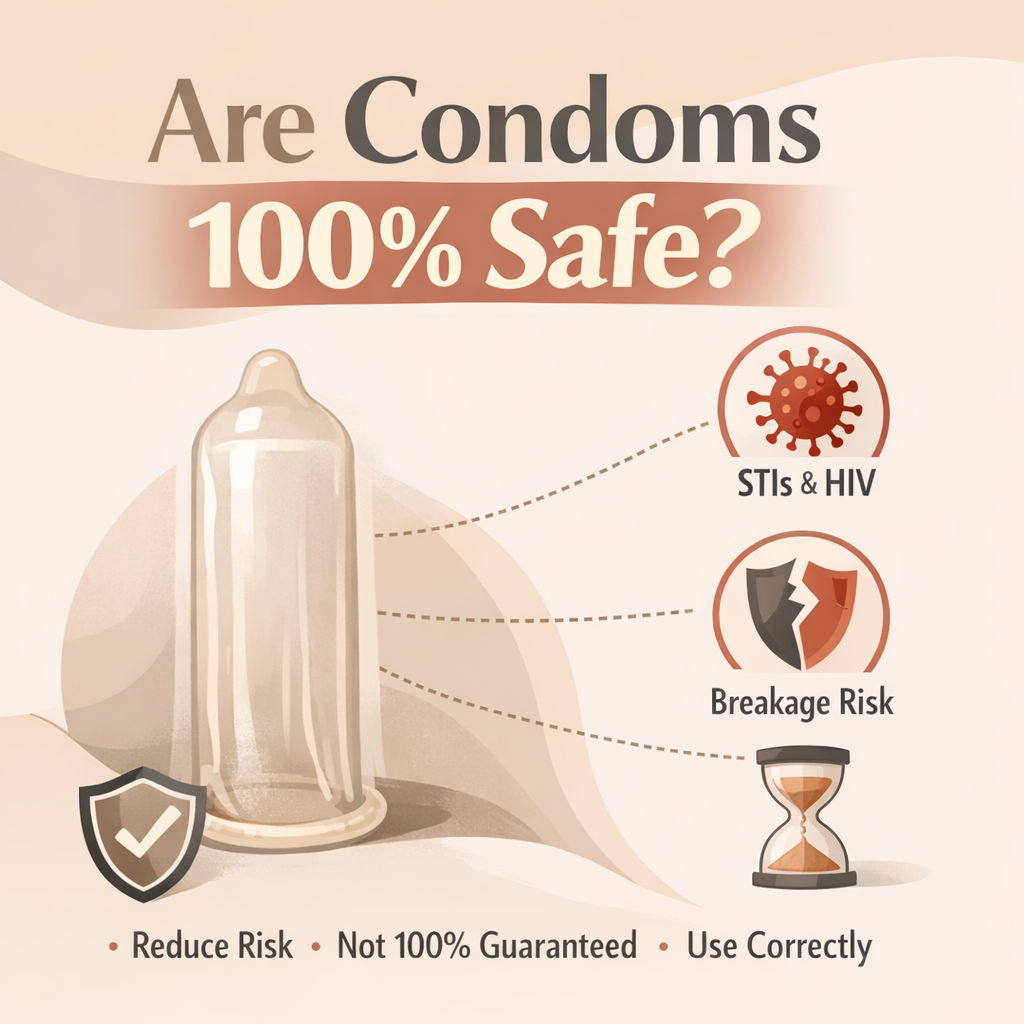
This guide explains what condom effectiveness really means, why condoms can fail in real life, and how to use them more safely and confidently.
What “Safe” Really Means
When people search “Are condoms 100% safe?”, they are usually asking one of two things:
- Can condoms completely prevent pregnancy?
- Can condoms fully protect against STIs?
The honest answer is no — not completely. But that does not mean condoms are unreliable.
In sexual health, “safe” usually means reducing risk significantly, not removing risk entirely. That distinction matters. Condoms are especially valuable because they provide dual protection: they help reduce the risk of both pregnancy and many STIs.
That is one of the biggest reasons condoms remain such an important part of safe sex planning.
How Effective Are Condoms for Pregnancy Prevention?
Condom effectiveness depends heavily on how correctly and consistently they are used.
Perfect Use vs Typical Use
This is where many people get confused.
Perfect use means:
- the condom is used correctly
- it is used from start to finish
- it is used every single time
- no mistakes are made
Typical use means:
- real life
- late application
- inconsistent use
- wrong technique
- fit problems
- storage mistakes
- lubrication mistakes
With correct and consistent use, condoms are considered highly effective at reducing the risk of pregnancy. But in real-world situations, effectiveness drops because people make small but important mistakes.
Do Condoms Protect Against STIs?
Yes — condoms are highly effective at reducing the risk of many STIs when used correctly and consistently during vaginal, oral, and anal sex.
They are especially useful for reducing the risk of:
- HIV
- many fluid-transmitted infections
- overall sexual health exposure
However, condoms do not eliminate all STI risk completely.
Some infections can spread through skin-to-skin contact in areas that are not covered by the condom. So while condoms provide strong protection, they should be understood as high-risk reduction tools, not absolute guarantees.
That is why the most accurate message is this:
Condoms are one of the best protection methods available — but not 100% perfect.
Why Condoms Fail in Real Life
Most condom failures are not random. In many cases, they happen because of avoidable user-related issues.
1. Wrong Size
A condom that is too tight may stretch too much and increase the chance of tearing.
A condom that is too loose may slip off during use.
Fit matters more than many people realize.
2. Late Application
If a condom is put on after sexual contact has already started, it cannot provide protection from the beginning. This reduces both pregnancy and STI protection.
3. Not Enough Lubrication
Too much friction can increase the risk of breakage. Using the right lubricant can help reduce stress on the condom and improve comfort.
4. Using Oil-Based Products
Oil-based products such as:
- coconut oil
- body oil
- lotion
- petroleum jelly
- Vaseline
can damage latex condoms and increase the risk of failure.
5. Expiry Date and Poor Storage
A condom that is:
- expired
- overheated
- crushed in a wallet
- stored badly for long periods
may become less reliable.
6. User Error
Many condom failures happen because of simple mistakes, such as:
- not leaving space at the tip
- not squeezing air out
- rolling it on incorrectly
- using the wrong lubricant
- removing it carelessly
- not using it throughout the entire act
How to Make Condoms Safer and More Effective
If you want condoms to work as well as possible, focus on the basics.
Use This Simple Condom Safety Checklist
- choose the right size
- check the expiry date
- make sure the condom packet is not damaged
- store condoms away from heat and pressure
- put the condom on before any genital contact
- leave space at the tip
- squeeze out trapped air
- use enough compatible lubricant
- avoid oil-based products with latex condoms
- hold the base during withdrawal
- never reuse a condom
- do not wear two condoms together
These small habits can make a big difference in both comfort and reliability.
Common Myths About Condom Safety
There is a lot of misinformation around condom use. Let’s clear up a few common myths.
Myth: Condoms are 100% safe.
Fact: They are highly effective, but no method is perfect.
Myth: If a condom fails once, condoms do not work.
Fact: Most failures happen because of preventable mistakes, not because condoms are useless.
Myth: Condoms only prevent pregnancy.
Fact: Condoms also help reduce the risk of many STIs, which is what makes them a dual-protection method.
Myth: Any lubricant is fine.
Fact: Oil-based products can damage latex condoms and increase breakage risk.
Myth: Wearing two condoms gives extra safety.
Fact: Wearing two condoms at once can increase friction and make breakage more likely.
Are Condoms Enough on Their Own?
For many people, condoms are a strong and practical protection method on their own. But some people prefer to combine condoms with another method for added pregnancy protection and better peace of mind.
That extra step depends on personal goals, risk level, and comfort.
If pregnancy prevention is the primary concern, some people choose to pair condoms with another contraceptive method. If STI protection is the main concern, correct and consistent condom use remains extremely important.
Frequently Asked Questions
1. Are condoms 100% safe?
No. Condoms are highly effective, but they are not 100% perfect. No contraceptive or STI barrier method completely removes all risk.
2. How effective are condoms at preventing pregnancy?
Condoms are highly effective when used correctly and consistently. Their real-world effectiveness becomes lower when mistakes happen.
3. Why do condoms fail?
The most common reasons are incorrect use, wrong size, poor storage, late application, using oil-based products with latex condoms, and friction-related breakage.
4. Do condoms protect against STIs?
Yes. Condoms reduce the risk of many STIs when used correctly and consistently, but they do not eliminate all STI risk completely.
5. Can condoms break even if they are not expired?
Yes. Even an in-date condom can break if it is used incorrectly, damaged, stored poorly, too tight, or used without proper lubrication.
6. Does lubricant improve condom safety?
Yes. The right lubricant can reduce friction and lower the risk of breakage. It is important to use a condom-compatible lubricant.
7. Is one condom enough?
Yes. One properly used condom is the correct method. Using two condoms together can increase friction and raise the chance of failure.
8. What should I do if condoms keep breaking or slipping?
Repeated condom failure usually points to a problem with size, storage, lubricant, or technique. In that case, switching fit or reviewing how you use them is important.
Final Takeaway
So, are condoms 100% safe?
No. But they are still one of the most effective, affordable, and accessible ways to reduce the risk of pregnancy and many STIs when used properly.
Most condom failures are caused by preventable mistakes, not because condoms do not work. That means the right fit, correct technique, proper storage, and the right lubricant all make a real difference.
Used correctly and consistently, condoms remain one of the smartest tools for safer sex.
Medical Disclaimer
This article is for general educational purposes only and does not replace medical advice. If you have concerns about STI exposure, pregnancy risk, or repeated condom failure, speak with a qualified healthcare professional.