Can I Use Extra Lubricant with Condoms?
Yes, you can use extra lubricant with condoms.
In many cases, it is not only safe — it is actually helpful.
Extra lubricant can:
- reduce friction
- improve comfort
- help lower the chance of condom breakage
- make condoms less likely to slip or feel draggy during use
That is why the better question is not “Can I use extra lube?” but:
“What kind of lube is safe, and how should I use it properly?”
The most important rule is simple:
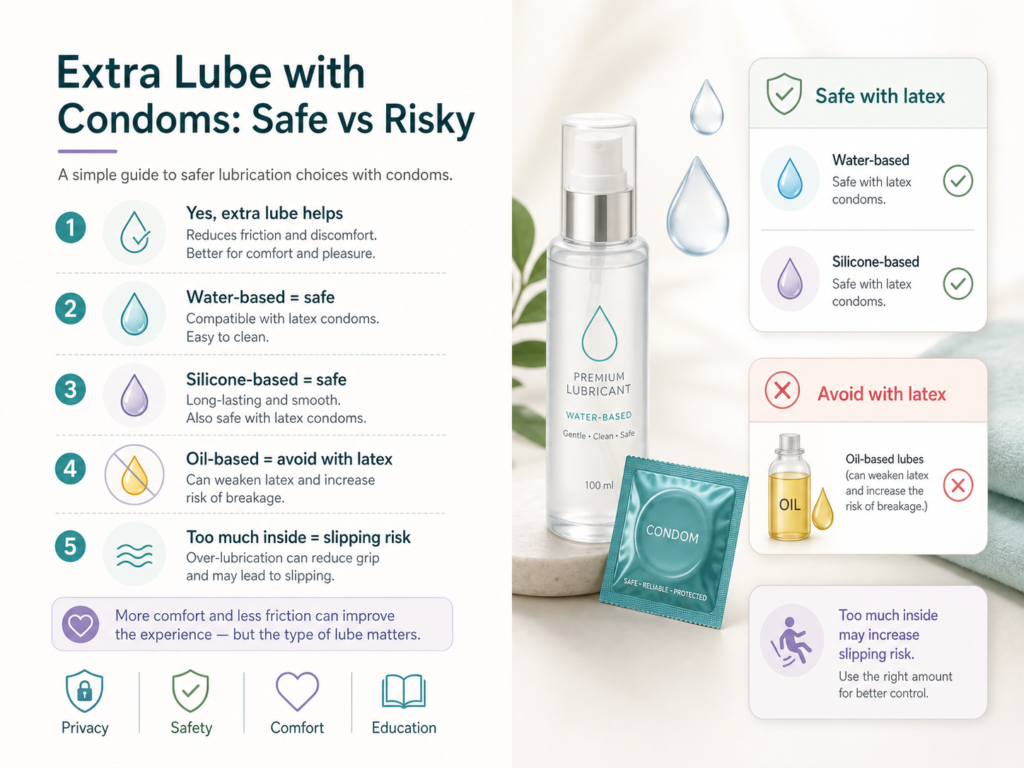
Use water-based or silicone-based lubricant with condoms, and avoid oil-based products with latex condoms.
Quick Answer
If you want the short version:
- Yes, extra lubricant can be used with condoms
- It can improve comfort and reduce friction
- Water-based and silicone-based lube are the safest general choices
- Avoid oil-based products like coconut oil, petroleum jelly, lotion, or baby oil with latex condoms
- Too much lube inside the condom can increase slipping risk
Why Extra Lubricant Can Help
Most condoms come pre-lubricated, but that does not always mean there is enough lubrication for every person or every situation.
Natural lubrication can vary, and friction may increase during:
- longer sex
- dryness
- certain positions
- anal sex
- times when the condom feels slightly uncomfortable or draggy
That is why extra lube can help in three practical ways:
1. More comfort
Less friction can make condom use feel smoother and less irritating.
2. Better condom performance
Less friction can help reduce breakage risk.
3. More confidence
When sex feels more comfortable, people may be more likely to use condoms consistently.
This is what makes lubricant one of the most underrated parts of safer condom use. It is not only about pleasure — it also helps the condom perform better.
Which Lubricants Are Safe with Condoms?
Water-Based Lubricant
Water-based lubricant is the safest and easiest starting point for most people.
Why it works well:
- condom-safe
- beginner-friendly
- easy to clean
- works with latex and many non-latex condoms
The main trade-off is that it may dry out faster than silicone-based lube, so you may need to reapply it during longer sessions.
If you want the simplest default answer:
Start with water-based lube.
Silicone-Based Lubricant
Silicone-based lubricant is also generally safe with condoms.
Why people like it:
- lasts longer than water-based lube
- provides smoother glide
- needs less frequent reapplication
- useful when more lubrication is needed
This can make silicone-based lube especially helpful for:
- longer sessions
- higher-friction situations
- people who find water-based lube dries too quickly
If you are using silicone sex toys, check the toy’s care instructions first, because some silicone lubes may not be suitable for some silicone toy surfaces.
Oil-Based Products
Oil-based products are the main problem category with latex condoms.
These include:
- coconut oil
- petroleum jelly
- baby oil
- massage oil
- body lotion
- hand cream
- butter or cooking oils
These products can weaken latex and increase the chance of breakage.
So with latex condoms, the safest rule is:
Avoid oil-based lubricants completely.
Your source also includes a useful nuance: some non-latex materials may have different compatibility rules, but for general user guidance, the safest advice remains simple:
When in doubt, choose water-based or silicone-based lube.
How to Apply Extra Lube with a Condom
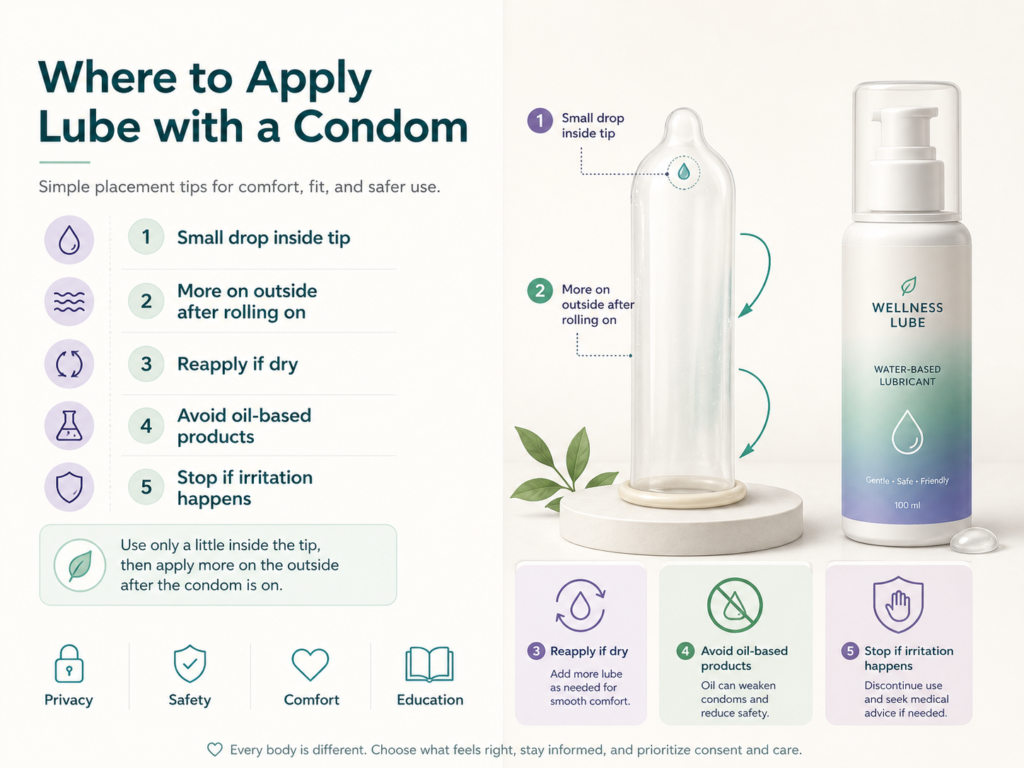
You can use extra lubricant in two main places.
1. On the outside of the condom
This is usually the most important place to add it.
Why?
Because it reduces friction during use and helps the condom feel smoother and more comfortable.
This is also the best place to reapply if things start to feel dry or uncomfortable.
2. A very small amount inside the tip
Some people add a small drop or two inside the tip of the condom before rolling it on.
This may improve sensation for some users.
But there is an important caution:
Too much lubricant inside the condom can increase slipping risk.
So if you do this, keep it minimal.
Simple Step-by-Step Method
Here is the easiest way to use extra lube with a condom:
- Check the condom’s expiry date and wrapper condition
- Put the condom on correctly
- Add condom-safe lube to the outside
- Reapply if things start to feel dry or uncomfortable
- If the condom slips, breaks, or the situation changes, use a new condom
That is the cleanest and safest routine.
Can Too Much Lube Cause Slipping?
Yes — especially if too much lubricant is placed inside the condom.
A small amount inside may help sensation for some people, but the main lubrication should usually go outside the condom.
A useful rule to remember:
- Outside the condom: usually helpful
- Inside the condom: only a small amount, if any
- Too much inside: may increase slipping risk
If slipping happens often, the issue may not be lube alone. It may also involve:
- condom size
- fit
- erection loss during use
When Extra Lube Is Especially Useful
Extra lubricant is especially useful when:
- there is dryness or discomfort
- sex lasts longer
- friction feels high
- condoms have broken before due to friction
- the condom feels draggy or uncomfortable
- condoms are being used for anal sex
This last point matters a lot. Your source specifically notes that lube is especially important during anal sex because the rectum does not have natural lubrication.
So in many real-world situations, extra lube is not a luxury — it is simply good practice.
Common Mistakes to Avoid
1. Using oil-based products with latex condoms
This is the biggest mistake. Oil-based products can weaken latex and increase breakage risk.
2. Assuming pre-lubricated condoms never need extra lube
They still may need more depending on dryness, friction, or duration.
3. Adding too much lube inside the condom
A little may be fine, but too much inside can increase slipping.
4. Using numbing or desensitizing products casually
Some products can change sensation in ways that make it harder to notice discomfort or friction.
5. Ignoring irritation
If a lube causes burning, itching, redness, or discomfort, stop using it and try a different formula.
Myth vs Fact
Myth: Condoms already have lube, so extra lube is unnecessary
Fact: Extra lube can still reduce friction, improve comfort, and help lower breakage risk.
Myth: Any lubricant is safe with condoms
Fact: No. Oil-based products can weaken latex condoms and cause breakage.
Myth: Silicone lube is unsafe with condoms
Fact: Silicone lube is generally condom-safe.
Myth: More lube inside the condom is always better
Fact: Not always. Too much lubricant inside can make the condom slip off.
FAQ
1. Can I use extra lubricant on a pre-lubricated condom?
Yes. Adding extra water-based or silicone-based lube can improve comfort and help reduce breakage.
2. What type of lube is safe with condoms?
Water-based and silicone-based lubricants are the safest general options.
3. Can I use coconut oil with condoms?
Not with latex condoms. Coconut oil is oil-based and can weaken latex.
4. Can I use petroleum jelly or lotion with condoms?
No, not with latex condoms. These products can weaken latex and increase breakage risk.
5. Can too much lube make a condom slip off?
Yes, especially if too much is placed inside the condom.
6. Is extra lube important for anal sex?
Yes. Lube is especially important during anal sex because there is no natural lubrication there.
7. Should I stop using a lube if it causes irritation?
Yes. Stop using any lubricant that causes burning, itching, redness, or discomfort.
Final Takeaway
Yes, you can use extra lubricant with condoms — and in many situations, it is a smart idea.
Extra lube can:
- improve comfort
- reduce friction
- help lower breakage risk
- make condoms feel smoother and more natural during use
The safest general rule is:
- use water-based or silicone-based lube
- avoid oil-based products with latex condoms
- keep most of the lube on the outside of the condom
For readers, the easiest way to remember it is this:
Extra lube is helpful — the right lube is essential.
Medical Disclaimer
This article is for general educational purposes only and does not replace medical advice. If you experience repeated irritation, burning, itching, or discomfort with lubricant use, consult a qualified healthcare professional.